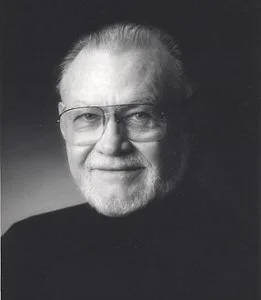
Van K. Brock is the author of The Hard Essential Landscape, The Window, Unspeakable Strangers, and other collections. He grew up in South Georgia, earned his MA, MFA and PhD at Iowa, and taught creative writing for several decades at Florida State University. He founded Sundog (now the Southeast Review), International Quarterly, and Anhinga Press. He and his wife, Flavia Maria da Silveira Lobo, divide their time between Tucson and Rio de Janeiro. Van passed away in 2017.
His most recent book available from Anhinga Press is Lightered: New and Selected Poems.
Author photo: Beverly Frick
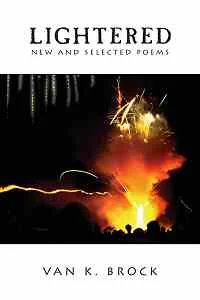
The way "pine needles speak their sibilants to the green/ pecans," Van K. Brock's LIGHTERED speaks to me. The book's title refers to highly combustible, sap-rich pine, and his poems - suffused with a strong sense of public and private history, Dixie-haunted, world-struck - sizzle and snap on the tongue and in the mind. Brock knows how to brush just enough strangeness into our speech to make it song and to make it last. He's been to the sacred wood and brought back fire. -- R T Smith
Van K. Brock is a poet to cherish - and read! - for his sense (wisdom) and skill in bringing the secrets of our time to us without spoiling the mystery. These lightered poems give brief strong light to family tragedies, evidence of ancient, too-present crime. And there are folktunes here, much music in the words for dancing, the washing screaming to be hung "in the sun like saved sinners." -- Michael Mott
Scholarship, love of nature and family, the honoring through poetry of art, music, and travel, indignant witnessing to history's evil absurdities - these and many other passions assure the power of Brock's chromatics. He hears even the shards of mosaics as songs that awaken epiphanies, and there's grief in his poems that we are too often fragmentary man, with some parts - perhaps the most essential for our humanity - unfinished. I've followed his work for years. I value this up-to-date definitive collection. -- David Ray
The Empty and the Naked
(from "Passages from Pandora's diary")
They say there is a cavity in us waiting to be filled, but
there is no cavity until we have been penetrated. The cavity
is their creation. Their nakedness, however, is certainly
waiting for women to clothe it. And when we have clothed it
and they have filled us with their longing, the fruition is neither
us nor them.Our longing is yet to be fathomed.
If you believe you are right, you can do any evil and consider
it a virtue. Soldiers treat their enemies better than their wives;
mothers and fathers beat their children; and all unselfishly
credit the gods. And they blame that which they desire most;
they blame women; they blame all women in one woman.
They blame me for all that is defective in themselves.
Curiously, this creates the law of inequality by means of which
I can assign all error to the other -- race, gender, city, and even to
the gods. Laid in intricately woven syntax, the cuckoo leaves its
heritage in the word "they." How better can nest-stealers merit
their name?
The loveliest girl in Hellas is rightly the most cynical, but the wisest
is the most compassionate.
These Words
The words I had for you were small
presents saying light things, and I had
filled them with my breath, like a bouquet
of balloons. Then, I thought they might
float off unless I tied them to you
or pressed them firmly into your grasp.
So I stayed up all night making them
into inflatable lifeboats. I know you know
they are too small to ride. Also,
they often crash although they sail up
rivers we have only dreamed, and even
disappear, with their secret cargoes,
into those distant interiors where
you may find one ripped open on a sharp
day, addressed to where you are, these
words, strewn among wave-smoothed pebbles,
but the cargo still there. Rare coins?
No. Only little phones that keep ringing
until you answer and the operator says,
"A person-to-person call: will you
accept the charges?" And I will say, "No,
Operator, it‘s person-to-person only.
The toll is paid." And to you: "The coins
are in you, not in those boats I made.
When you look inside, you will see.
The flipside is a map whose face is yours."
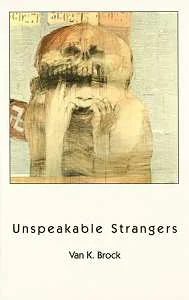
These are very bold and powerful poems about [of course] practically the most difficult theme in the world. I read them with increasing admiration for both [the] mastery of imagery and control. Never once [do they] slip into the sentimental and that in itself is an achievement. But mainly I am impressed by the pervasive music, the requiem sound. -- William Styron
The Hindenburg
This early showpiece of the Thousand Year Reich used 850,000 skins of cattle for hydrogen bags.
It is said that the night it burned
the thunder of panicking hooves
drowned the screams of passengers.
As far away as the buttes of Asia,
one old Siberian woman says that merely
the echo of their lowing still stirs
immense winds and whirlwinds.
All the small meadows of Europe
remember their grazing. Cattle cars
and railway platforms shudder still
at their foreshadowings.
Untold cobblers
recall the million seams glued and stitched
on screaming machines before their pockets
held enough hydrogen to kindle a conflagration.
The war on nature begun,
eventually, every country in Europe
and many in Africa and Asia were gutted:
in bombings, in battle, at sea, and in the fires,
filth, and hunger of virulent slave pens:
the outward rendering of ageless accumulations
sucked up from the cities and villages of earth,
and the ruins run in and out of us all,
stretching before and behind
for far more than a Thousand Years.
The Survivor
for Viktor Frankl and Martin Buber, for the songs
You want me to make a speech?
Yes, I survived. Some of the best did not.
What's worse: nightmares or their absence?
Sometimes I talk without stopping.
Specters conspire with my life,
threatening me with prophecies:
"Make meaning of sacrifice."
Sacrifice? For what. Each found
something to suffice or nothing to survive for.
One man recited songs he had made out of teeth.
There were two blooms on that bough,
and a woman who went up in smoke
looked out from this hut and said,
"I often talked to that tree."
"And does it reply," I asked.
"Yes, it says, ‘I am here.
I am life. Eternal life.'"
"Ah! Lebensraum," I laughed.
Since no man wanted to hear,
the Chinese poet played
to the gods on his jade flute,
then men inclined an ear.
So do these grim forms
long for men to clasp them,
for played on a flute of bone,
they aren't for the gods alone.
Then later he fell into silence.
There are silences heavier than stone.
None knows to whom they belong
or for or from whom they are kept.