
Kelle Groom’ s poetry collections are Five Kingdoms (Anhinga Press), recipient of a Florida Book Award and recognized in Entertainment Weekly’ s “Best New Poetry,” Luckily (Anhinga Press), a Florida Book Award winner, and Underwater City, selected for University Press of Florida’ s Contemporary Poetry Series. Her work has appeared in The American Poetry Review, Best American Poetry, The New Yorker, New York Times, Ploughshares, Poetry, and The Writer’ s Almanac with Garrison Keillor among others, and has been recognized in the Pushcart Prize and Best American Non-Required Reading anthologies. Her memoir, I Wore the Ocean in the Shape of a Girl (Simon & Schuster), is a Barnes & Noble Discover Great New Writers pick, New York Times Book Review Editor’ s Choice selection, a Library Journal Best Memoir, B & N Best Book of the Month, Oprah O Magazine selection, and Oxford American Editor’ s Pick. A 2014 National Endowment for the Arts Literature Fellow, she also is the recipient of fellowships and awards from Black Mountain Institute, University of Nevada-Las Vegas, Library of Congress, and James Merrill House, among others. Previously, Distinguished Writer-in-Residence at Sierra Nevada College, Lake Tahoe, Groom is on the faculty of SNC’ s low-residency MFA Program. She currently is the Summer Program Director at the Fine Arts Work Center in Provincetown, Massachusetts.

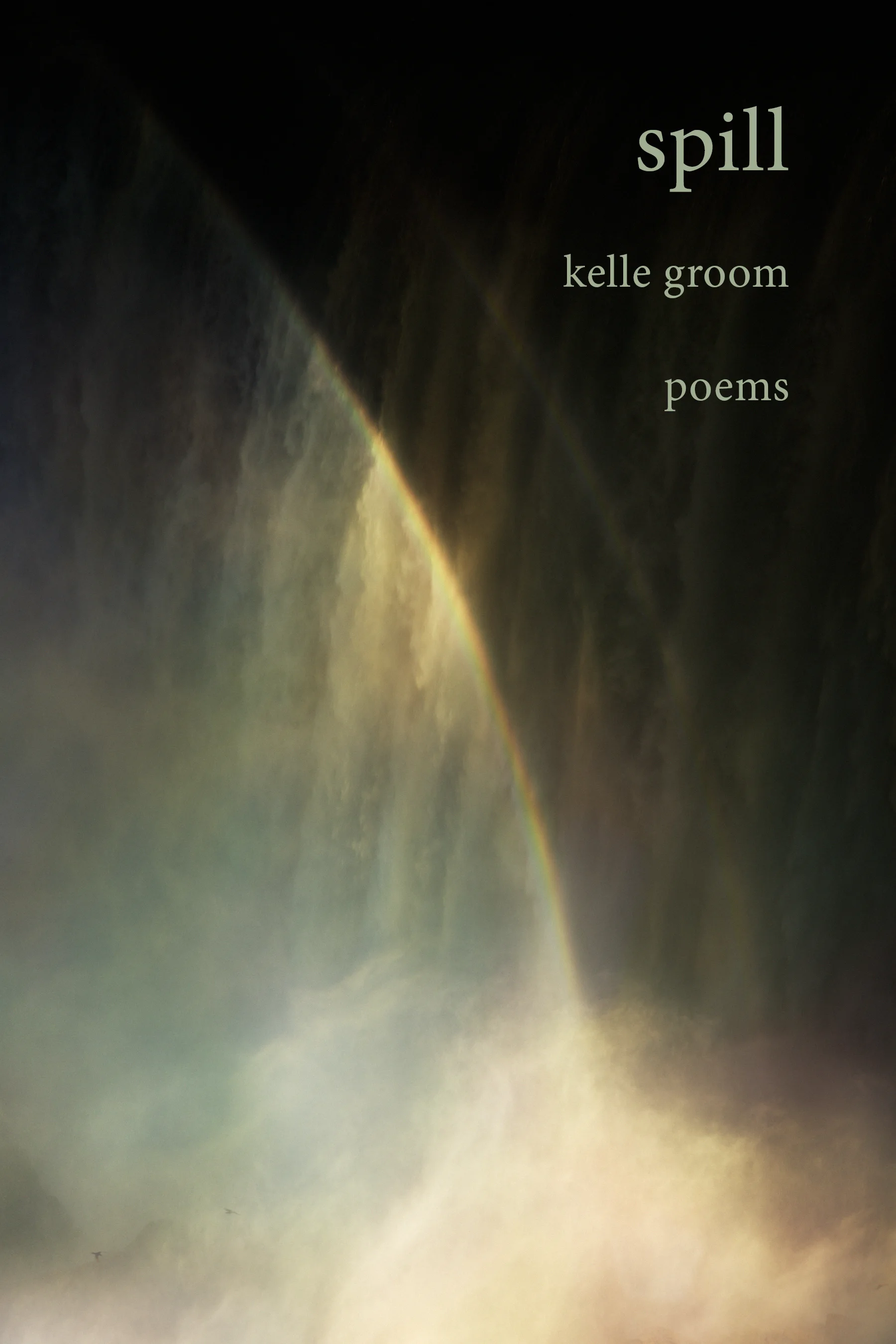
AVAILABLE OCT. 10, 2017
Kelle Groom's latest collection, Spill, maps an ever-shifting terrain of absence and profound loss with lyric intimacy, generosity, and necessity. These poems are imaginatively and aesthetically restless, exploring an interior landscape of memory while also recognizing that we live in a world of souls layered in trouble and delight. Groom's poems often counter-balance pain with a nuanced sense of humor, a humor born of great attention, and this, in turn, rises from a deep well of empathy. Early on, Spill promises — “If someone must saw open/ my chest I want all this light to be what spills out.” Kelle Groom promises a gift of light, and the poems in Spill make good on this promise. — Brian Turner
This book is an offering, an attempt to capture the quicksilver nature of consciousness, of what it’s like to move through our world of burdens & joys. In “The Face of Jesus,” Kelle Groom offers this: they believed the children had been sent / to help them better learn to love, which lifted / me out of my own body for a moment. Be warned: you will find yourself — in all your glory & in all your confusion — in these poems. — Nick Flynn
Kelle Groom’s newest book of poems tells it slant, as we are tipped into her world with a hand that seems both inconsolable and utterly aware. These are poems charged with her singular imagery, (stitched down by her expansive, ravishing lines), and this work of being both inside and outside a body, a room, a door, a house, is how we leap with her, as if we’re always on the verge of some fairy tale, familiar but without end, all while her heart is populated with a certainty about uncertainty, and as she tries to find what she has lost but holds ever so near. — Sophie Cabot Black
When I finished reading this urgent, restorative book, I wanted to turn to Kelle Groom — because it felt as if she were really there — and say, “Thank you for the honor of letting me stand inside this so-large heart while the world went on spinning in its unforgiving, totally forgivable way.” No joke. Some rare books you actually get to rest inside of, protected by the writer’s trust and wisdom. This is one. — David Rivard
In Kelle Groom's Spill, I finally understand why love is always the third phrase we learn in a new language after we learn goodbye. Here, home is a coast, birds appear like visitations, and the heart is a door the ocean stutters through. These poems break me open, but then let language heal around the wound. For Groom, nothing — not even love — is unspeakable.
— Traci Brimhall
’ AMOUREUSE
She has the colour of my eye,
She has the body of my hand
— Paul Eluard, trans. Samuel Beckett
She has the Kansas City of my open window
She has the halogen of my bent blinds
And her hair is in my hair
She has the fresh breeze of my borrowed flower sheets
She has the freestyle of my squeaky metal bed coils
She has the sonic boom of another’ s blood beneath me
She has Any way you want it that’ s the way you need it outside
her window in the summer dark
And her hair is in my hair
She has the breaking point of my hard plastic pink flipflops
She has the hypnosis of my shuffle to the kitchen for coffee
She has the conversation of my black caterpillars in their fur
coats, curling uncurling by the door last winter,
hello, hello
She has the song and dance of my rage turned against the self
And her hair is in my hair
She has the touch and go of my fear
of death by emotional starvation
She has Bachman Turner Overdrive playing Takin’ care
of business outside her window & a man who says:
We’ re gonna mix it up we’ re gonna find a sixth person we’ re
gonna get trashed
And her hair is in my hair
She has the Santa Ana of my sense of basic flaw
and unlovability
She has the atavism of my narcotism
And her hair is in my hair
She has the jet lag of my pocketbook
She has the sonogram of my happiest childhood memories
She has the frailty of my recollection
She has the ultra-red ultra-violet ultra-sonic ultra-short
ultra-mundane ultra-montane ululating ultimatum
of my solitude
And her hair is in my hair
INCURABLE
An open door is an invitation
Spirit if you don’ t have land what are you
What was my cove
before the door of my throat
I kept breaking irreplaceable things
One night, the front door — hinges rusted
by salt and age — detached, opened into my arms like the lid of a coffin, or
a body I could barely hold, had to lay down on the deck.
THE FACE OF JESUS
I was thinking about why souls have bodies,
what can a body do that a soul can’ t,
and about the Amish or Mennonites, the ones whose
children were so sick with the same disease
that struck generation after generation,
until finally one doctor figured out how
to help them. But while he was figuring,
he asked them about the disease
and their kids, and the people said
that they believed the children had been sent
to help them better learn to love, which lifted
me out of my own body for a moment,
reminded me of when a church responded
to my request for money for some of the homeless
people in my town. I opened their response,
sitting in my closet office
with tiny bugs trying to drink the water
out of my eyes, with the small oblong window
in my door like on the doors of the insane,
the impounded, so someone can see in
to be sure the one inside hasn’ t hung herself,
but small enough that she can only see
the outside world as the size of an envelope,
when I opened the church letter
and read it, I was so surprised that they thanked
me for being the face of Jesus. I thought how
can I be the face of Jesus, I’ m not even that
nice, and I’ d certainly had many unkind thoughts
about my co-workers just that morning
especially about the woman built like a truck
who was always trying to run me down.
But though it seemed an over-the-top thing
to say, like naming me Pope or Cardinal,
I realized that a spirit would need hands
to touch someone, and that the person
who has those hands and that body can be flawed
and sick and crazy, selfish and withdrawn,
and sad, and still be an instrument of love,
like when a musician gave up
on teaching me to play Summertime,
and simply laid his hands
on top of mine, banged my fingers into keys.

Van K. Brock Florida Poetry Series (2009)
Kelle Groom's poems are like underwater songs, sung from the submerged continent of the inner life, the life we don't often expose to the outer world, the one we don't speak of. They have the bemused slightly sad knowledge of lived life, but mainly, these poems come from the muse of soulfulness, they are "tender-minded" -- they balance honesty with perceptiveness of others, which is the true sign of tenderness. They are wry, artful, sad, loving, and moving. A true pleasure. -- Tony Hoagland
Kelle Groom's new book, Five Kingdoms, attempts to categorize the world, make sense of its violence, loss, and beauty. Groom makes the unbearable bearable through lists, ekphrasis, wild associations, and ritual. Her poetry cross-references politics, biology, history, domesticity, and war. Her work glows with her spirit and intellect, explodes with joy and grief. Five Kingdoms sings with what it is to be human. -- Denise Duhamel
Kelle Groom's beautiful poems are haunted by a rare intuition, a sense that things are more than what they appear. -- Malena Mörling
Groom likes to set vivid scenes -- a fireman speeding to an emergency, a hitchhiker risking a dangerous ride -- and then lift them into poetic bliss. She's also capable of flights of fancy that end up unexpectedly moving. -- Ken Tucker (Entertainment Weekly)
Five Kingdoms
What is the blue in the temperature drop?
Is the stove doing its arithmetic
so that heat is not just felt but seen?
Do you know the whereabouts
of the color photograph of a dog,
tide tables, a car down below?
What is the plan for your own and another's vital
signs, the rose red yellow? If you drape
the windows with seaweed,
is that the simplest means for extinguishing
the species? Do you keep all of your money
under the bed because of the cold war,
because those now living lay down years ago?
With the dropping of the first bomb, did our average age
limit drop? If we place lucky objects, perform
activities a special number of times, if we are ugly or disfigured
in some way, and we diagnose our contact with live
animals, broken glass, auto exhaust garbage
grease and solvents, lead, can we forgive our impulse
to rob, steal from, cheat, for causing harm to others
with our thoughts, training a blow torch
on hundreds of thousands until their skin came off like gloves,
a child a white flash running in the street. Recite
the lucky numbers and the multiples,
collect and remove tacks razor blades nails lit cigarettes,
touch them before using, before you break in two, categorize
the five kingdoms, count all the living things.
Eviction
I walked on boards broken by the hurricane
into a shack with the windows blown out,
slept in the limbs of the house, in blue T-shirts,
ocean, night sky, the wind glassy, waves below
always coming toward me, wanting to play,
and when I open up in the nightlight to slide down
the dunes, trusting the hurricane debris of planks and lost
alligators, nails and bricks, will make way,
the ocean dresses the door of my apartment in town
with notices, over and over; then the sheriff
posts his letter, hear ye, hear ye, like a medieval
broadside, and in 24 hours, he's back to cart
my belongings to the curb--donated furniture,
my grandmother's books, Bible, the dirt from my son's
grave, birth certificate with the official green stamp,
every word I've written--it's all tumbled in car exhaust,
the homeless men by the lake coming to take a look
like seagulls on their tippy-tip feet.
Loud House
Het up boys, skitter boys, muttonchop
go-go boys, gurgle music, kidney stone
music, muchachos party, rubicon sand fire
flaring party, thunderbird ski hats in summer
party, sweaty head party, pound & thump,
socket burning beach party, orange forklift
beach, orange moon ba-boom, hooch smoke,
ta-ta smoke, stonkered house, pandemonium
tetherballed, turtle orbitted, oriflamme ant
house, rust hilled, I know I'm violating
myself house, Maybe you'll see me
on MTV house, No, dude (to a dog) house,
evening knock knock knock knock
house, evening anamatter clink: glass and tin,
goo food jars, chest hammer music, earthmover,
dog bark music, beep beep back-up
talk, rag and straw sleep, panic sleep, dart
sleep, rummage, rumple, canyon sleep,
sulky bunco, mittenheaded boys, saw-
voiced reclamation boys, fumarole,
radio pale, tar breathing boys
in the chewed grass, white sail an exhale.
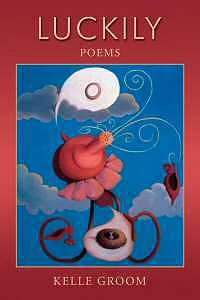
Van K. Brock Florida Poetry Series (2006)
In Kelle Groom's Luckily, tenderness transforms violence: "A kiss on a cigarette burn." In poems both mysterious and candid, Groom captures domesticity and dream, internal and external landscapes, addiction and recovery. Groom is pitch perfect when it comes to emotional nuance. She constructs flawless images about our miraculous, vulnerable bodies. Luckily is a fierce and important book. -- Denise Duhamel
Kelle Groom's exhilarating poems put human intoxicants (like love) close to hand. As they sweep a sometimes painful burden of experience along one unforeseeable line after another, they also offer a crash course in how, when forgetting's not an option, memory takes another deep breath and works like mercy. -- Terri Witek
Kelle Groom has the eye for image, the ear for music, and the finger to turn words into gold nuggets. Underwater City is a phenomenal first collection of poetry, and Luckily takes us to a higher peak. -- Wang Ping
Coat
A coat hung in a pine tree outside my bedroom window
like a seamless tan nightgown
displayed in the 1977 Kansas City exhibition
of North American Indian Art -- the Algonquin coat or Cree
from the early nineteenth century, pre-reservation,
mooseskin coat with caribou, red and gray pain washed
away, the porcupine quills a woman chewed and softened
in her mouth, sewed on the shoulders, come loose.
I walked into the grass to get a closer look,
and a man in a blue truck stopped on the quiet dirt,
asked if I had seen a moose.
He'd found tracks up in the field
where the hunters park their campers.
No, but here is his thin coat, moving and alive,
waving as if on a clothesline,
waving like so many leaves.
Black Feathers
I saw you fade from doorways, saw you broken loose on a train.
Carrying brown bags overflowing with food,
I asked how you could have left with no goodbye.
You were young as when I held the sad Italian girl
in your window, words from underwater gripping me
as if I were slippery. I meant to see you off
at the airport, but when you let go, we were on a plane
lifting off over water, my bags gone, purse, all money.
When we landed in Paris, my clothes disappeared.
Leaving the airport, we walked down stone steps
into the city - you wore a long black coat like the angels,
holding your left arm around my body, dressing
me, right hand below my heart. You said we'd see Rodin's
knee, but we stopped at the house of your friends --
the son broke spaghetti into boiling water, the mother crazy
and gray, alone on the fenced-in grass, her husband
just watched. The daughter gave me a sapphire dress,
her grandmother's who she loved and missed,
soft cloth in a tissued box. You somewhere else
in the house, but your hands still covered me.
I heard your voice, and said I was afraid of not finding my way
back through the streets, the terminal, all that language
and water. Looking up from the sapphire blur, you were
next to me on a train home, arms around my waist, hands
meeting at my hip, coat sleeves soft, black feathers.