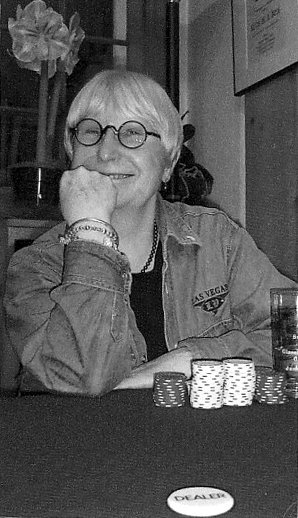
Diane Wakoski, who was born in Southern California and educated at UC, Berkeley, lived and began her poetry career in New York City from 1960-1973. She has earned her living as a book store clerk, a junior high school teacher in Manhattan, a library story-teller, a Visiting Writer and, for ten years on-the-road, by giving poetry readings on college campuses. Since 1975, she has been Poet in Residence at Michigan State University, where she continues to teach as a University Distinguished Professor.
Her work has been published in more than twenty collections and many slim volumes of poetry since her first book, Coins & Coffins, was published by Hawk's Well Press in 1962. Her selected poems, Emerald Ice, won the William Carlos Williams Prize from the Poetry Society of America in 1989.
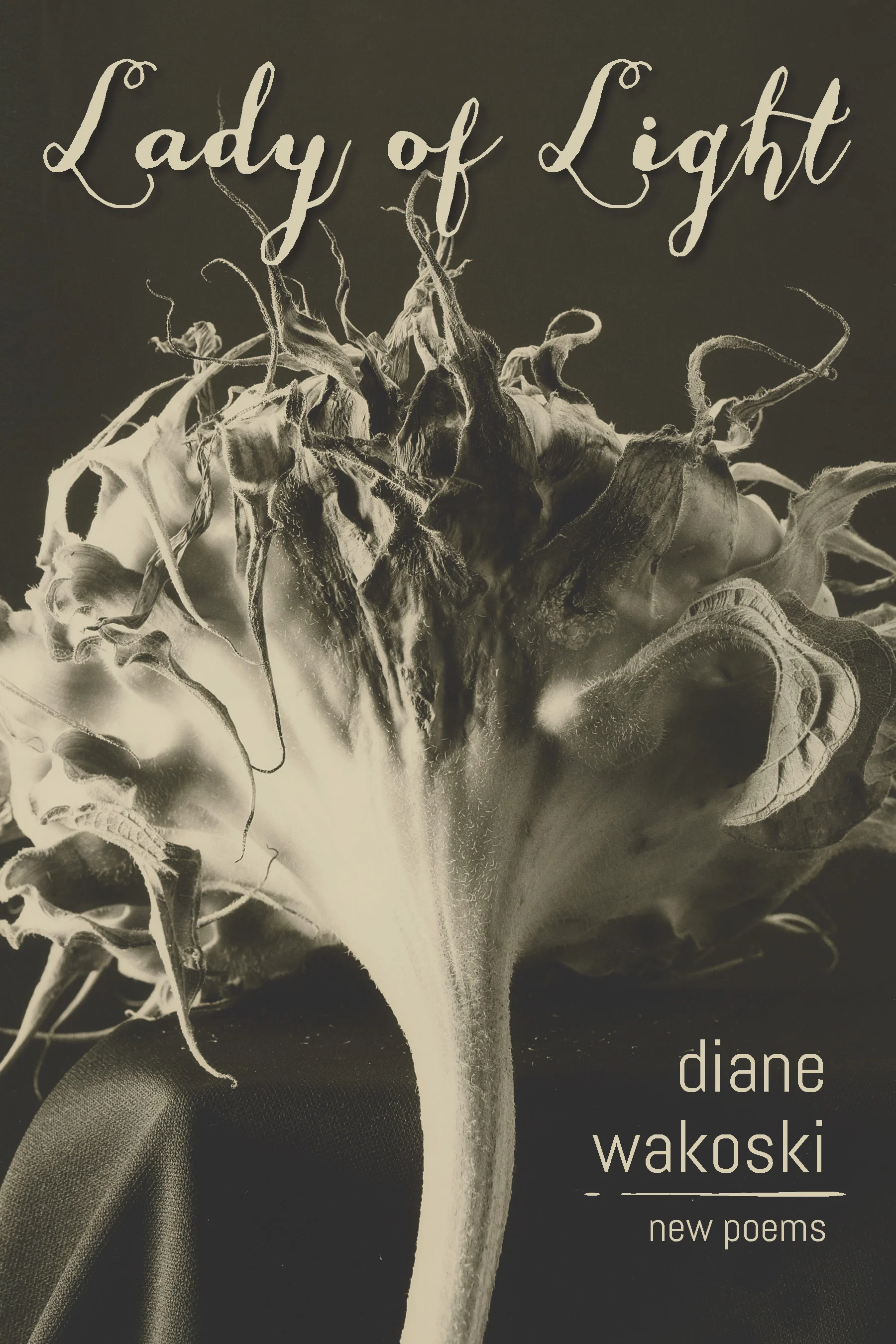
Her collection Diamond Dog was published by Anhinga Press in 2010. Bay of Angels, also from Anhinga Press, was released in October 2013. Lady of Light was released in 2018.
My name, Diane, declares
Moon Goddess, it too an oxymoron
as I control nothing,
not tides, or madness, not lovers,
or night blooming flowers. My name,
like so many names,
extravagantly, ironically, belies my organic or
celestial natures.
— from “Sea Thrift & Gorse”
April 1
found on our driveway
like a feather dropped
by a crow
8 of spades,
a playing
card/
we played Crazy Eights, slapping
cards or holding them
as if they were birds that might fly
out of our hands
decades ago, in our childhood
like the translucent, whirling,
image I imagine, prismatic and phosphorescent —
a murmuration of starlings swooping
and iridescent
But it dissolved onto a grey wall, undecorated
/ glimpses of us wearing our
velvet Sunday best dresses, yours
usually crimson, mine blue
— from “And Now She Has Disappeared in Water”
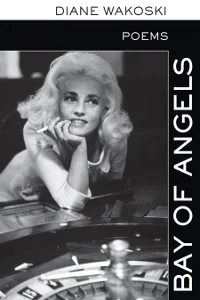
[The 1963 film starrng Jeanne Moreau] La Baie des Anges is in beautiful black and white that won't make you regret the lack of color. It is an existentialist film, but one that doesn't seem dated. The romance is not gaudy, it's believable -- both about gambling and about love. Since gambling and love are two reasons for excitement, two activities that teach us about ourselves, and two misunderstood human diversions, it seems that this film offers so much. The Bay of Angels, of course, is a place, but to me it's where I'd like to drown, with angels all around me, holding cards and offering me poker chips, should I ever have to die that way. -- Diane Wakoski (from the Introduction toBay of Angels)
This wonderful book is about so much. Beauty, youth, aging, love, art, passion, loss, and style are only a part of what makes the whole, and the poems are intimate, as though you might be sitting at the table with her eating a triple crème cheese and sipping a perfect wine as she sates all of your senses. -- review by Maryfrances Wagner, at We Wanted to Be Writers
Szymborska's Cigarette
When silver bangles clashed on
my young arm, as my
sturdy harpsichord-playing fingers were
shooting that one winning craps game,
I was for a moment the woman
on film.
What a pale girl I had been,
smoking Russian cigarettes,
playing solitaire, always
watching the high school Jimmy Deans, whose eyes
were silver bullets. Once I was caught
in the black and silver of a motorcycle jacket, and once,
I was caught grinning in an artists' café,
masked
in smoke,
against discovery. Yet,
so few moments of extraordinary beauty
remembered from a long life: the bracelets singing thinly
in Las Vegas as I threw and threw the dice, making everyone
at the table rich; sitting alone in the Berkeley café creating
a moonlit bookery out of espresso
and celluloid longings; walking among spring plums blossoming
in San Antonio and realizing the flowering trees
smelled like tortillas; being photographed
in New York by a camera
that saw me as Polish amber, soft resin of trees, wings
of dragonflies. Lacy memories
cling to my hair, embedded
like cigarette smoke from the invisible man,
King of Spain, who has,
this lifetime
loved me. I invented him
that one night,
out of dice and emerald
green baize,
out of the slinky, winning touch,
gliding up my arm
and down almost over my wrist:
a lifetime's arc of silver bangles.
Cleaning Up Petal Drop
Gathering the,
large as goldfinches,
fallen yellow tulip
petals
and their eyebrow-thick
black stamen,
I sweep them
into the plastic-lined
trash bin and think, "The Silk Road,"
for the petals form a ribbon, lustrous
and flowing, too ancient with the sound
of cartwheels rolling thru
what might as well be The Steppes,
down into the world of roots
where my brother, David, lies.
Even the act of brushing them into the wastebasket evokes
bolts of silk and tins of Russian Caravan tea,
all the wealth that once was
coffee beans of Arabica
tulip bulbs of Amsterdam
woven skeins of mulberry China.
They lie there, a river of canary and black,
discarded from
their Fulper Pottery vase,
and, along the luxurious edge of our own
spring Silk Road called Division Street,
I will snip more buds
from Steelman's cool April garden.
for Robert aka Steelman who makes the garden
Gravel
Yellow wings flash by the feeder,
and make me realize I am not
alone. standing at the glass door / watching,
taking a risk, a glance
behind me -- sense the shadow boy holding
a piece of malachite.
It drips, a waterfall of green
confusion. Yesterday there was
gravel under my foot
on the kitchen floor and
for the first time I saw figures
flying into the backyard,
black chevrons on their wings, which were like
yellow sails.
Once I was a woman. Once I too was huge,
perhaps a meteor. Now
having looked behind me,
stunned by brightness and
immensity I rattle, a piece of
gravel, infinite, infinitesimal,
to the kitchen floor. Never am I
alone when I see those yellow vaulting
wings, always with the shadow boy who
tracks in feathers and is surrounded by an
absinthe-green waterfall
rushing into a pool,
lit up with sunlight cast
by the immense wings
captioning and thudding at my door,
a yellow furnace on the verge of swooping into
the rain forest of my kitchen.

The Diamond Dog, Diane Wakoski’s 19th collection, calls into being a world where the scientific and the mytho-poetic interact and combine. Here, in her first collection of entirely new work since Argonaut Rose (1998), planets move in the perturbed ellipses of warped, Einsteinian space. Yet too, in the realm of the Diamond Dog, stars still turn in their Ptolemaic spheres. Here, the air can be Linden green, Lorca green, and the stem of a carnation can be the line on an astronomer’s spectrograph, the signature of oxygen in some distant star.
Though these intricately-written poems chase outward across innumerable landscapes -- the streets of New York City, the glacier fields north of Juneau, a kitchen on the day of a dinner party, a collapsed star made entirely of diamond, the island of Crete, the kingdom of Colchis, Plato’s cave, a Midwestern college campus, an empty avenue on an afternoon in Majorca -- everything about these poems pulls back toward a center, toward "crystal packed into point." It is a story of separation, absence, and of the Diamond Dog itself, an emissary, searching out what has been lost to the poet.
Diane Wakoski's poetry has always put me in touch with the original and fresh and mysterious lyric impulse I felt when I read her work for the first time 40 years ago. I have re-experienced this awakening with every book of hers, and once again with The Diamond Dog. -- Mark Jarman
She is still an important and engaging poet, one whose bloodlines go back to the early history of contemporary free verse. And this book in particular should have a special relevance for young poets and their teachers, since it shows how, through personal mythmaking, one can bring out of the heat and pressure of one's life a hidden beauty. -- David Kirby (Christian Science Monitor)
Red Tether
A boy in some Dickens school
tipped his inkwell
and poured out a continent
of black sail, lines flapping as
a map crackled
in her luggage. Thrust and parry.
Tight,
a bud, a parachute,
the crystal still packed into point,
the miniature ship,
lines collapsed, before
it's in the bottle.
Puffy coat,
a trip to the Azores,
the carnation she found while walking
her dog on the lake,
its stem a green line of oxygen,
the dog's leash a Red Giant,
the fog off the lake that rendered thoughts
of disappearance,
none of this relevant to the lost pilot or
the girl visited --
a visitation! --
on the beach by Amelia Earhart,
whose navigator went down with her,
but of whom we never speak.
My Diamond Dog, never
on a leash, it's always
running away.
Her dog
is visibly tethered to her,
the Martian line glowing on a foggy beach.
The Silver Locket
On the hillside where goats threaded their way
through rocks, their
bells making the sounds of rattling
keys, she awoke with a silver locket.
Inside this silver dollop was the face of a Greek mariner
who loved her. Rags
left from the wedding so many years ago,
before her enchantment, hung
around her waist. A scrap
of dancing shoe embraced
her foot.
She couldn't
remember why they said the stars turned in crystal spheres
or that fire was invisible, but she danced
in cream satin shoes, she remembered;
and my little black shoes were gleaming crow feathers,
or the noses of seals, or jet or onyx lamps filled with oil,
the kind Aladdin found.
After the library at Alexandra was torched, there were
eight centuries of brindled flocks.
She, who was my mother and told me this story,
as I sat by the smudge-leafed orange groves
and watched black and gold spiders make webs,
had come through a portal,
a cone,
and thus awakened
with only the silver locket.
The rosebush was part of the story, and the
Diamond Dog who ran through the
yard one evening at dusk. Reading
of Queen Ann's Lace, she told me
I was a princess.
The locket held a picture of my
father, an Argonaut sailor,
when centuries were just buttons of pearl,
and time hung around her neck
like this silver locket.
Walking
Music's a wood you walk through.
-- David Mitchell, Black Swan Green
White scarf, woolen, Sarah's gift from Argentina
where she learned to tango, is around
my neck,
and I am walking on Tolstoy's estate, more
than a hundred years ago,
a girl with feet
as small as cornets or bugles, shaped
like ermine, or lab mice,
nicely shaped,
those feet. But it's the white wool, a harness
of bells, a knitted gliding step
into passion
that fills the woods. Russian novels, Rachmaninoff
concertos, cheeks that are pomegranate
red: these are conjured
by the branches, stripped for winter, the way they will
crackle as kindling when starting a fire behind
the grate where
my foot will rest as I scrape the rime off
my walking boots and unlace them.
When I enter the
drawing room stocking-footed, the Diamond Dog will be
lying
on the hearth. Maybe this is a
story by Chekhov, not a Tolstoy novel,
though what I
am really hearing is music and no path through it.
The witch's house is not far, I am
told, but why
should I want to go to a fairy tale? It's the cup of smoky
Russian Caravan tea that I'm hoping
for, and someone,
not imaginary, to drink it with.
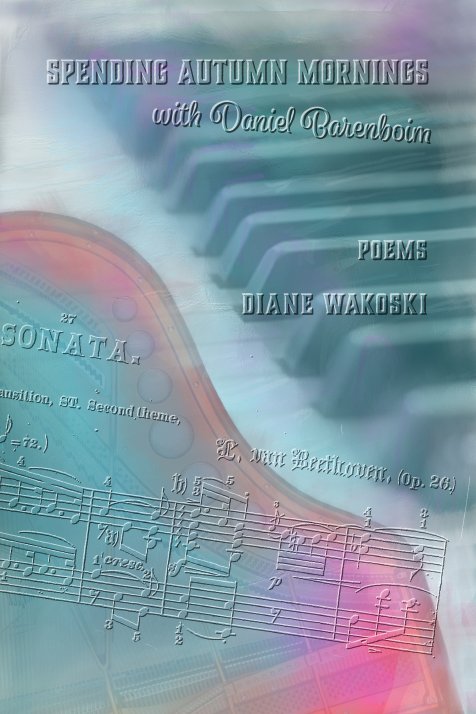
This chapbook reissues the stunning final section of “Lady of Light.” Lush with sensory detail and memory, The poet listens to DVDs of performances by the renowned classical pianist, Daniel Barenboim, every morning for the autumn season as she prepares for her day. Wakoski trained seriously as a pianist in her early years and the poems respond to his performance with acute observations intertwined with musing about the day to come.
The Waldstein I
When I listen to Beethoven’s sonatas,
especially watching a video
of a pianist performing them,
it’s like the useless act of putting a bandage
over an old scar,
the wound long healed, but healed in
a rather jagged, raised, lurching line.
The precision and exact touch of the virtuoso
seeming so natural, simple, that I
can assume it, as if I were playing —
knowing that in another’s body this extravagant
dream of my youth came true.
Listening this morning to the “Waldstein,” sonata #21,
I hear his passion for the countess, married to
one of Beethoven’s patrons whom the
piece is named for. Beethoven
supposedly fell in love with her, at least the
music sounds as if it could be a
passionate address. I wonder if
Daniel Barenboim is playing it
for his own love, Jacqueline du Pres?
The second movement, so grave,
coming after the first one, which gallops,
rushes, releases, then dives headlong
back into the racing heart. This second movement is like
a funeral song, solemn,
reverent, contemplating the loss, of love perhaps?
Its slow rhythms given up,
and the galloping triplets of the first movement remembered.
Daniel B.’ face so serene as he plays the second movement,
Slow and then dreamy,
the sustaining pedal coming into heavy use,
so that melodies and phrases echo, and are heard as if under water,
the memories of what once was,
for it becomes hasty and heavy
with dire longing, even when it morphs into the third movement,
there becoming urgent and demanding. Daniel B.’s faun’s ear
just appeared to me, as if the music has reinvented him. The inside of the
piano is glowing again. He has lit it from
inside.