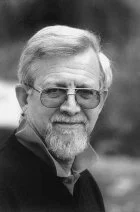
Robert Dana was born in Boston in 1929. After serving in the South Pacific at the end of World War II, he moved to Iowa where he attended Drake University and The University of Iowa Writers' Workshop.
His poetry has won several awards, including The Delmore Schwartz Memorial Award from New York University and two National Endowment for the Arts Fellowships. He revived and edited The North American Review in the sixties and also operated The Hillside Press. Retired from teaching after forty years as Poet-in-Residence at Cornell College, he has also served as visiting writer at Stockholm and Beijing universities and at a number of American colleges and universities.
Dana was appointed Poet Laureate for the State of Iowa 2004 through 2008. He died in February, 2010, of pancreatic cancer.

310pp
About Yes, Everything:
The apparently gentle ingenuousness of Robert Dana's deft and durable poems is deceptive; it conceals a sturdy, hard-earned sensitivity, an open-eyed and open-hearted readiness to confront whatever comes for it, to keep whatever in pain or joy proves worthy of keeping. -- C.K. Williams
About What I Think I Know:
There is a lifetime of love and loneliness in these poems; and bitterness, and knowledge. Even a little happiness. Always loveliness and good music. And amazing craft. And a night hawk's soul. -- Gerald Stern
About Starting Out for the Difficult World:
A Dana poem seems not crafted but improvised. Yet it is about as "effortless" as a jazz solo that brings to bear years of experience. You hold your breath as the poem takes place. -- Edward Brunner
Dana's poems are about the hard truths he has come by but telling them slant, as another highly quirky poet put it. Slant and almost word for word. I don't know another poet who weighs his words more than Dana does. He works with a careless and fearless mind, a fierceness and delicacy of feeling, a great subtlety of craft and an intense localness of vision. -- Ted Solotaroff
If these new poems are more relaxed formally, they are still in the vein of meditations on death and love and nature and beauty. I think of Keats, Stevens, and Roethke, also poets whose formal restlessness and trust in the imagination never managed to obscure their unmistakable voices. Good company. -- Jeff Gundy
I'm Lucky
Sub-zero.
And the birds have lost their talent
for the air.
.com
My neighbor across the street
and down, died this morning.
Of colon cancer. Ending
four months of watching
birds in his back yard,
and eating ice cream, his pain
dumbed by a morphine drip
so carefully calibrated
only a machinist, which
he was, could fully
appreciate it. And his wife.
Such a fine and terrible
day to close out a life.
The first morning, really,
you could see your breath;
sunlight slicking every
still-green leaf. The air
windless, brisk, and edgy.
Then, the white van. Not
a hearse. A plain white
van in the drive. No
lettering at all. Just
two men. One in an uncle's
tired brown suit; his bulky
companion in shirtsleeves
following; both walking
as if in bedroom slippers;
wheeling their gurney up
the lawn to the rear of the house
through the sparkling dew,
past the red geraniums
and drifts of pink impatiens --
www.death.com
It's early. No children
maunder yet toward their
orange bus. And young
couples, behind the closed
doors of their duplexes,
ready themselves for a day's
work. Not a car passes.
In such suburbs, no
aproned women approach
death's door bearing
covered dishes. Later,
I'll remember how he gave
away his last precision
tools. And still later,
bedroom shades will be
raised, windows opened,
and air enter the house,
and light, and silence.
Back yards
blank with snow. Drifted.
Trampled.
The breath of trees
stripped bare.
My neighbor's blue Maverick
deafens, blind and hub-deep,
on exactly the same spot
he parked it last September.
This wind could cut glass,
freeze your finger to your cheek.
My life is not important.
I understand that.
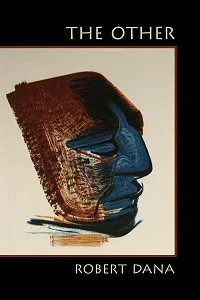
Approaching eighty, Robert Dana, in The Other, seems younger and more vigorous than ever. There are laments here, certainly, like the touching poem about his friend and fellow writer Donald Justice. "The book is closing on my generation," he writes about his childhood hometown, but he then goes on -- with etching clarity -- to make the lost eras come alive. He takes us with him "under the red and gold of Woolworth's Five and Dime," and brings back other times so that yesterday, even though lost, becomes today again.
But The Other is more than a book of recollections. This is a book about the edgy beauty of our world right now. Its subject is the world's "terrible unfamiliarity" and one more instance of Dana's life-long quest for a language accurate enough to reckon the days we live in. The poems are, by turns, dark with the politics and violence of our era or joyous with the delights he finds in his rose garden and on his beloved beaches.
These aren't poems about things so much as they are poems that embody the "whatness" of the things themselves. Dana wishes, near the end of "Everything in Its Own Green Time," that his books breathe. Certainly that's the great pleasure for the reader of The Other: that we catch him in his poems -- the ageless soul in a bittersweet world.
-- R.M. Ryan
Elegy for a Hometown
I’m done now with the dark houses of the East.
My hometown.
The book is closing on my generation.
*
Skinner satin mills
long gone to producing brass & machine gun clips
& milk bottle caps
are now themselves long gone.
And the orchard of 10,000 apple trees
that fed our insatiable boyish hungers —
a wilderness of stumps and weeds.
*
Even the river’s changed course,
leaving Walpole’s cove bleached & dry, where, in winter,
local farmers sawed thick blocks of ice,
skidding them up a frozen ramp to waiting wagons,
horses named Belle & Sophie stamping & steaming & shaking
their harnesses until they rang.
*
My Polack neighbor’s dairy farm’s now a golf course,
tees & greens & easy fairways.
We once killed black snakes there through the long summers
& forking up corners,
saved the sweet-smelling, windrowed hay from oncoming rain,
chaff stinging our sweat drenched bodies like shirts of nettle.
*
So what’s to say when a whole chunk of your life
comes up missing?
You say to yourself, “Well, there it is.”
Or. “Well, there it was. Wasn’t it?”
*
God’s his own voyeur.
*
After more than half a century,
I walk the town with the only man who knows my name.
*
Soon, I’ll bury my own shadow & slip away like sunlight.
*
Simplicity’s what I’m best at.
*
In the end,
a small box of a house by the sea.
No electricity.
No running water. Dirt floored.
Prayer,
wind & slapdash from the whereafter.
Like the red admiral, which uses all of the known wing strokes of flying insects, Robert Dana employs an astonishing range of poetic strategies to describe the pleasure and pain of this fraught moment in our history. And just as the brightly colored butterfly animates these pages, now lighting on a domestic scene, now flitting through a meditation on the nature of poetry, so Dana steps lightly "down some moonless fractal, wild refraction, unpredictable reflection." His clarity of vision and economy of means enact an exuberant encounter with the world; his vivid reading of his walk in the sun -- "Alive on the breath-edge of metaphor" -- is at once bracing and wise. Robert Dana is a magnificent poet. -- Christopher Merrill
In this, his tenth collection of poems, Robert Dana surprises, delights, and may even momentarily confound his readers with this ambitious book which is, above all, a work of transformations. "Heaven is here, not there" -- Dana says, and these poems invite us to "Dance... down this senseless, bright dingle of commingling and delicious confusions" so that we, too, can say, with the poet, "Every day I live I live forever." -- Richard Holinger
The Morning of the Red Admirals
for D & L
We saw them first
last evening -- two,
spiralling up
a column of late
sunlight, then,
tilting away
from each other
in a floating stagger
through the early
summer leaves --
a jittery dipping,
dropping, rising --
one coming
to rest a moment
on the still warm
roof of our fat
pagoda lantern,
the other on weathered
deck rail;
the tips of its
long antennae
beaded and bright;
wings black,
white dot
and blue dot,
and barred aslant
with orange red,
laid flat,
then clicking shut
to dull grey sail,
then opening again.
Now, it's morning;
you've gone to work.
The air gleams,
dry and clear,
almost Greek,
and a half dozen
admirals sip
from the lilac blossoms,
still signalling
their unsayable
story. One
lights on my shoulder
as I hang the day's
laundry on the line,
shirts and drawers,
dull socks,
our flapping colors
answering his.
He's weightless,
this migrant --
a small, wild
scrap of grace --
and I'm his resting
post on the way
to whatever far
edge of creation
breathes at the tips
of his wings.
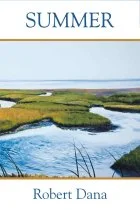
Another poet passing seventy might be ready to call his latest collection Winter. Not Robert Dana, who never seems younger than in this, his eighth book. Summer is about vanishing things that disclose anything but their frailty. It is "our enduring strangeness" that Dana affirms in his angular montages. About that which is off-to-the-side, no one is quite so sumptuously descriptive. Out of what others pass by as nothing, out of the "Black/ganglia of bare trees," Dana makes a "net/set to snare the first/bird that flies" to produce, again and again, like a prestidigitator, a bird that struts its stuff, "cocky as a robin on ice." Robert Dana has become our most elegant flaneur in the realm of the speculative--the walker whose strollings through the world produce a "murmurous celebratory music/for a discontinuous life." -- Edward Brunner
Dana... sings beautifully. -- Gerald Stern
Fog
I've lost my voice in the morning fog.
Fog that's grounded the osprey,
the gliding pelicans with their great
beaks and bags, and the broad cape
of their wings, and that incredible collapse
into the sea, a dive with all the grace
of an orange crate gone to flinders
in mid-air, ending reassembled
again as a bird, in a graceful float
on the rolling waters. No cormorants,
eyes blue-green as bottle glass--
bright, fierce, indifferent--standing
on the rotten pilings of the long-gone
pier, drying their sodden black wings.
Only a few shore birds--gulls,
a handful of sanderlings running
like wind-up toys. The palms are still.
The waters of the Gulf, as if the fog
weighed on them like holy oil, are still.
The breathing surf says, Shush.
And shush. And shush. But, of course,
it says nothing. Nor do the strews
of bone-white shells the newly arrived
bend to and search for the few bits
of color, the one unbroken shape,
spell out a message. Men and women,
the few morning walkers, emerge
from the fog and fade away in fog.
The high rise condos; the new hotel
in two shades of lemon sorbet,
and all the architectural beauty
of a penitentiary; the little shore
houses hung with dusky bougainvillea
and deep verandas have all vanished.
The world is just beginning, or perhaps,
ending. I don't say anything smart
to myself in the voice I've lost.
I just keep a steady pace, my hands
clammy, sticky with salt and damp.
I know where I'm going, after all.
Maybe I whistle a little something,
or hum silently to myself as we all do.
An adagio, maybe, or some Chopin
tune I learned from my first
girlfriend; she was petite and Polish,
soft voiced, and used to kiss the chill
from my lips and warm me under
her navy wool coat on those fall
nights when my hands were freezing
and my teeth chattered. Or some
other boyhood favorite. "Stardust."
"On The Sunny Side Of The Street."
At Seventy
You don't see yourself
in the morning mirror
anymore. And you tell
yourself you're disloyal,
that you have a tin ear,
and can't tell irony
from kvetch. So what?
At seventy, you no longer
expect old friends
to love you, and you're
sick of stories of the past
because they no longer
matter. Nor do
the day-long silences
that sometimes fall on
you like a cool rain.
But you can't stop there.
To get it exactly right,
you have to stand before
the window, before
the great scrim of sunlight
falling through the woods;
the green wall of leaves:
oak, hickory, feathery
hackberry, the wild cherry;
the dogberry fruiting;
darting shadows of birds;
hearing the thick rush of
wild flowers down the damp
slope; tasting the bitter
bite of black, thrice-
boiled, late-morning coffee.
Good luck's your wife's
laughter. And the yellow-
eyed, grey smoke cat,
der Meistersinger, who
keeps a clock in his belly
and knows what time it is.
And your small, muscular,
green-eyed, clouds-on-milk
cat, who seeks, each day
on the living room floor,
the exact center of the universe,
give or take an inch
or two, east or west, north
or south, curling herself
under on it, folding in
her long paws, bouldering in,
as if to mark it clearly,
hold it firmly in place.

A special collection of Robert Dana's poems about the beaches of Cape Cod, the Outer Banks and Florida. A collection of what Dana calls "the great luggage of the sea," Hello Stranger is filled with sea oats and sabal palms and blues and willets and cockles and john-boats. Robert Dana's poems have both the tenderness and accuracy of Impressionist paintings. His beaches are washed and strewn with the understanding of a poet who uses language with uncommon accuracy.
Rapture
In the thick,Carolina night,
the great luggage of the sea
falls thudding and trundling
and tumbling up the stairs of
beach; its undertow hissing,
sometimes spitting, rolling
back on its own prolonged
susurrations; pouring in
loud hushes across planking
through the open bedroom door;
flooding room and mirror;
overwhelming our breathing;
drowning, almost, even sleep
in which something deeper
hurries away, and the day
repeats and repeats itself
like the heaven of the waves,
and we waken again to thrum
of diesel and the raging sun.