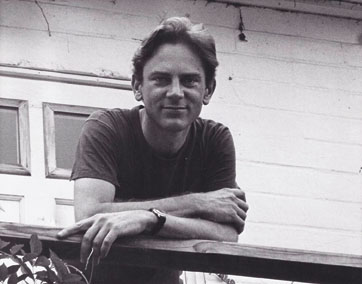
Lawrence Hetrick grew up in Gainesville, Florida, where his father was professor of entomology at the university and his mother a botanical researcher for the Florida Game and Freshwater Fish Commission. At the University of Florida he studied with Andrew Lytle, Smith Kirkpatrick, Robert Bryan, and John Goggin. After receiving a B.A. in English, in 1962, he did graduate work in creative writing at the Johns Hopkins University, studying with Elliott Coleman and Richard Macksey. He taught briefly at the University of the South (Sewanee, Tennessee) and Miami-Dade Community College before returning to the University of Florida, where he taught the first course offerings in poetry writing in 1967. In 1986 he moved to Atlanta, Georgia, where he taught at DeKalb College (later Georgia Perimeter). He served as editor of the Chattahoochee Review from 1997 to 2004, receiving the Governor's Award in the Humanities in 2003.
Over the course of his career he has published a variety of genres in journals and anthologies, including poetry, fiction, memoir, interviews, reviews of art and books, and historical scholarship. He also draws and paints regularly, but the core of his artistic practice has always been writing poetry. He is currently Associate Professor of English at Georgia Perimeter College in Atlanta, where he lives with his wife, Tracy, two teenage children, and two dogs.
The author and artist have been friends since 1967.
About the Cover Artist for Derelict Tributaries
Michael Kemp moved to Florida in 1955 from his birthplace in the remote Adirondack Mountains. During a three year journey from Daytona to Miami to Jacksonville to Bartow, with more than a dozen school changes, he shifted his educational focus to individual reading. After high school and three years in the U.S. Navy, he moved to Gainesville, Florida, in 1967, pursuing a degree at the university in biology, but with much interaction with the artists and musicians of the 60s social scene. A travel year in Europe turned his attention decidedly to art, and he returned for a degree in painting and printmaking under Hiram Williams and Kenneth Kerslake. During his subsequent career as a rural librarian in Micanopy, Florida, he earned an MFA Summa cum Laude in printmaking with Kerslake. Since retiring from the Alachua County library system, in 2005, he has established Harmless Pleasures Printmaking, a semi-public studio in McIntosh, Florida, where he continues to print his own work and to assist clients in printmaking projects.
His work is represented by Hector Fine Art (Gainesville), Ice House Gallery (McIntosh), and 53 Cannon Galleries (Charleston). He lives in a hardwoods hammock between Micanopy and McIntosh with his wife, a dog, and three horses. The emphasis of his prints has always been on rendering nature and everyday experience in a modernist context using ancient, direct methods.
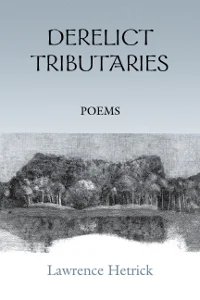
These beautiful poems are steeped in the dark tannin of loss. Redwater rivers, blackwater rivers -- they carry on, tributaries distributing memories through the sandy landscape of home. The poems are formally measured, with an elegiac economy, quiet Eliotic echoes, the ever-presence of rain, tupelo, eelgrass, sparkleberry, oyster shell, snake. As they sensually evoke the Florida terrain, these elegant poems say there never was a Paradise to lose, we have only ever owned recurrent waves of growth and inevitable regret. -- Sidney Wade
Lawrence Hetrick has given his collection of emptied landscapes, deserted promises, and dilapidated fields an accurate and telling title. Derelict Tributariesportrays a world "as real as what is here / and what is gone from here" with decisive, economical strokes, making a poetry that an artist like Edward Hopper would admire. Underneath the surface lies "an icy hope," but nothing is sentimentalized in this space as lonely as "a radio playing old songs / Till dawn in a dark gas station."
I like this collection immensely! There is something a little Hardyesque about it; the unflinchingness, I guess, but also the strong and lonesome presence of the observer. A strong book! -- Fred Chappell
A Visit to the Sandhills
I wake beneath a bare pine bole
Worn as a mule rib in drifted sand,
And my eyes wake rising up it
To find the pale land of the moon.
I can trace each gully and ridge
And hunt arrowheads in ash all day,
Unafraid of ghosts fled there for rest.
Dry ticking wind wakes in scrub oak,
And up the gully track a dust-devil
Whirls toward me. Between oldfield
Plums run ruts soft as flour,
Leaves like insect shells underfoot,
Under wagon wheels crunching,
Jolting over pothole pine roots.
Eventless sky smells like flint.
The wagoner's work is done. He laughs
Over his shoulder at the hilltop house,
Its clapboards silvered and splintering,
Chimneys cracked, windows broken,
Empty rooms howling Never,
The winter sky as blue as ever.
Canoeing to the Underworld
After a storm
Over windfallen trunks we haul,
Through broken branches, vine bound,
Under, around, between, and over.
After four days hauling, we know
We are doom-devoted. After five,
The river upside down, we slide
Under drowned leaves into cavern
Where flames drip, shadows smoke,
And dark closes like jaws behind us.
Shadow countenances crowd us,
Telling our unlikely futures
That we should be can't believe.
Under their coats more shadows snuggle,
Their unlived lives that look like pets,
Round-eyed and furry, with pointed teeth.
Perhaps we'd like to take one home?
Oh no, we're leaving now, done
Feeding blood to shadows so they speak.
Morning Fire
On an imaginary Suwannee, 1961
In winter's brittle, exile place
His face could be raw burnt with frost,
But he doesn't expect the perfect face
Of a mirror or the visit of friends,
Those lost like the very dead.
For him who keeps no face for friend
Or lover, there is a gentle, certain art:
Stirring the ruff of ash to find
Last night's embers' heart
Till wind quickens little flames
Flickering like his night-long dream,
Dance and dancer so perfectly seen,
Spinning like a figure in a music box,
Quick as flame, brief as snow flakes
Drifting at dawn on the white dune.