
Patricia Waters was born and reared in Nashville, Tennessee, taking her B.A. in English and History at what is now the University of Memphis. After completing several seasons in field archaeology in Europe, she completed her M.A. in English at the University of Tennessee Knoxville. Having lived as a teacher, journalist, and community activist in Memphis and New Orleans, she returned to Tennessee, to the upper Cumberland where her mother’s family pioneered, to rear her children, subsequently moving to Athens. A Pew Faculty Grant awarded while she was assistant professor at Tennessee Wesleyan College led her to writers’ conferences and repeatedly to the Sewanee Writers’ Conference where her relations with Howard Nemerov, Anthony Hecht, and Donald Justice were crucial to her development as a poet. She earned a Ph.D. in English at UTK, the poet Arthur Smith becoming a friend and mentor. A year as writer-in-residence at the University of Tennessee Libraries permitted time to gather her first book. She is currently an assistant professor in the English Dept. at Troy University where she oversees the secondary English Language Arts certification program. Her home is in Athens, Tennessee.
She is the author of two books from Anhinga Press: The Ordinary Sublime (2006) and Fallen Attitudes (2014).
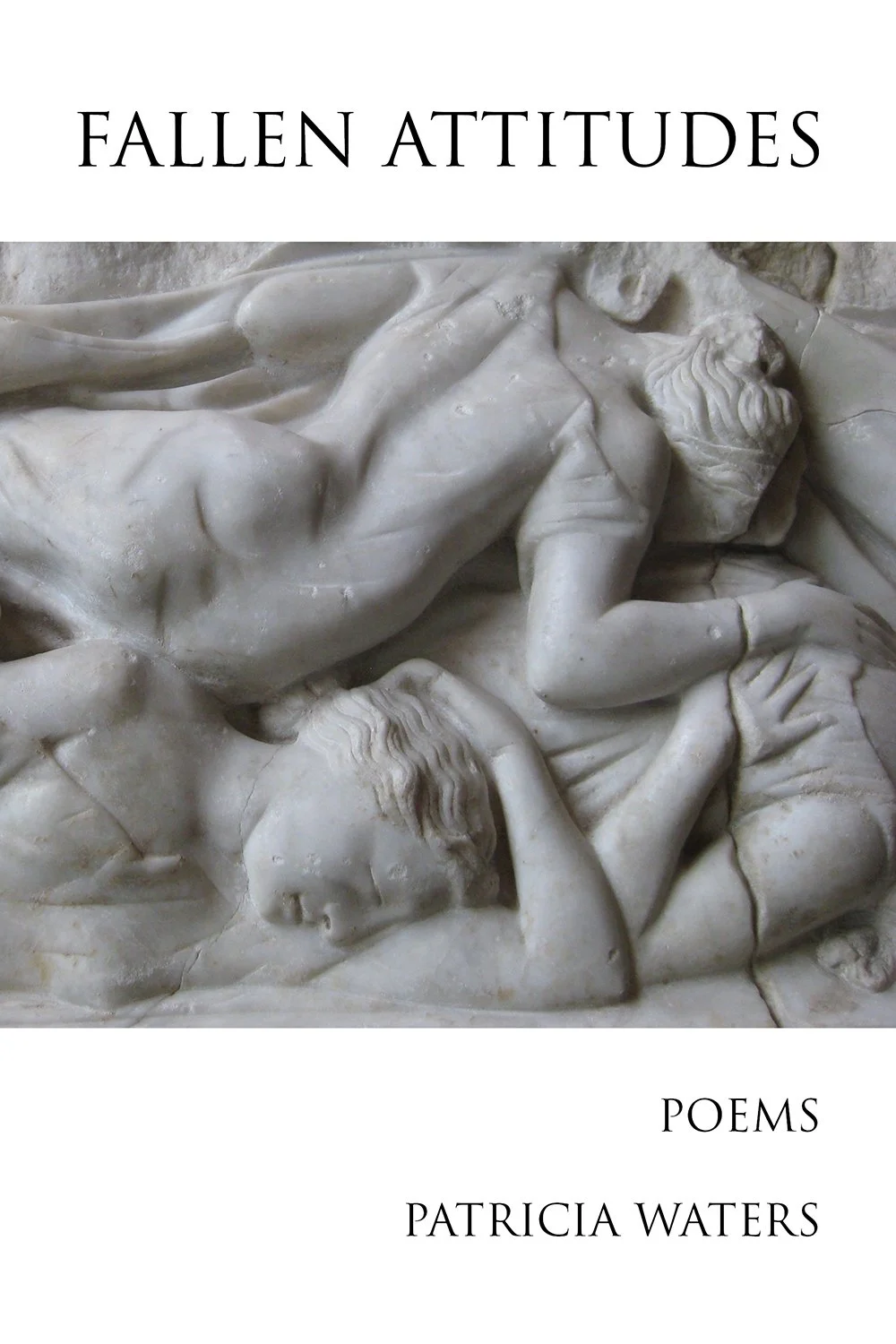
In Fallen Attitudes, Patricia Waters' poems explore, with intelligence and panache, the elusive "bitter realm of memory." With a classicist's viewpoint, she responds to the works of Symborska, Twombly, Bonnard, the ancient Greeks and the treasures of the British Museum. A world wanderer, but grounded in the American South, in its small towns and epic cities, she creates "the past's unraveled broiderie." From explications of the history of human sensibility and aesthetics, she has fashioned poems that become "that open kiss."
Look at that oak
swaying its green gray self.
I have not been here that long,
not at all,
it was planted before I was born.
This used to be an avenue of oak --
drought, disease, storm,
there has been damage
heavy shuddering thud, house rattling
as a tree or part of one comes down
but worst is the cutting down,
high whining chainsaw,
furious grinding chipper,
human hands feeding it,
followed by a worse worst --
the not planting.
Now there are three striplings of oak
in my yard (the arrogance of that possessive)
accidents of fall, of wind, of squirrel,
a seedling emerges --
they rise, taller, more leafed each year
trying to touch something,
seeking what no word can say.
They will pass me in this hurry
I call life, what the tree knows,
what the geese moving,
sawing the high air,
pass over twice a year
In the University Library
Standing in the periodical room, I read
while cold winter light diffuses from high windows
laying bare the magazines, newspapers, journals
on their blond wood shelves of bauhausian rigor
all angle and shadow, sharp and pale.
The periodicals, fewer in number each time I come,
are stacked just so, ready for the messy hand.
I love coming to this room, to its quiet --
so few people do. After all,
there are many more ways to fill leisure time,
more productive than being idly curious,
picking a journal from a shelf,
turning the pages to find a review essay,
a book about the last living Carthusian monks
who had entered the order before the rules,
before the world, changed,
those sad sad seekers of the Christ
in glorious gardens, in cold damp cells,
in hairshirts, in silence,
in the now now now of their vows.
Bonnard
What architecture is this color?
The table is laid. There are consequences.
He likes the moment before crumbs fall,
wine stains.
Bed, bower -- grunged linens --
he watches her being.
How many times does he paint her,
the goddess in her bath,
suspended in her island home
water her medium, she drifts,
body open, thoughts closed --
there is the interminable grooming,
talcs, lotions, files, brushes,
how much care the flesh demands --
painter's eye, yearning heart,
the pearl in its nacreous shell
eye's jewel, where light breaks.
The brush bathes the aging body
in juvenescent color.
He is permitted this realm
until the last banishment.
Again he paints the scene,
she, afloat in luminous porcelain,
surrounded by glowing tiles,
now he adds the little dog,
the beloved,
sitting beside the bath on its rug --
fawning, carnal, hers.
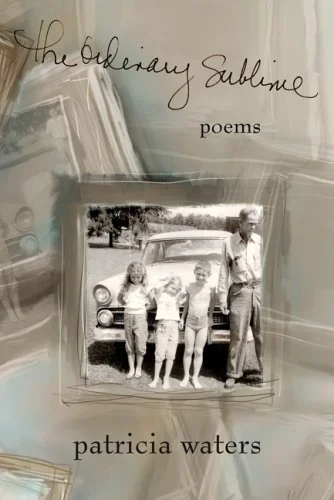
"A powerful, sobering collection of poems by Patricia Waters. A failed marriage is the framework, though its real focus is on re-learning how to see "daily life" as the "ordinary sublime." Not surprisingly, the arts play a central role throughout these poems--Vermeer, Rothko, Hopper--sometimes comforting, sometimes terrifying, but always serving as a standard measure for the speaker's experience: this is the authentic. It may be discovered in "Morning Coffee" (a brutal poem) or exhibited in the wry lyricism of "Girl" ("By the basin lavender soap/makes soft and sweet the sad old flesh"). If there is a signature piece here, it may be "As Heard Early Morning National Public Radio," in which the coast guard "rescues" a woman found three miles off the coast of Florida, "swimming, strongly, steadily/away from shore." You'll have to read THE ORDINARY SUBLIME to see what happens. It was well worth the wait."--Arthur Smith.
