Roxane Beth Johnson is the winner of the 2006 Philip Levine Prize in Poetry selected by Philip Levine for her manuscript Jubilee. Johnson's poems have appeared in ZYZZYVA, American Poet, Sentence, The Bitter Oleander, Chelsea, Parthenon West Review, and elsewhere. She has been a Pushcart Prize finalist and was a recipient of an AWP Intro Writer's Award in Poetry. She lives and works in San Francisco.
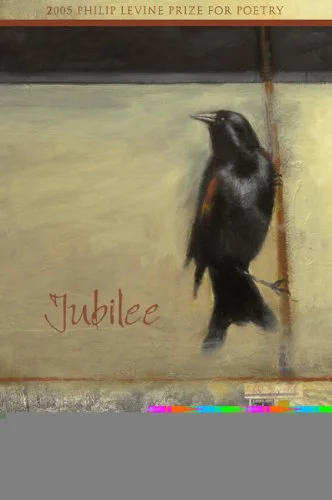
JUBILEE by Roxane Beth Johnson won the 2005 Philip Levine Prize for Poetry. "These luminous poems depict a world I never knew--or know as a child and since forgot--and they do so with the authority of a totally mature voice. The artistry that unifies JUBILEE is so perfect it is almost invisible. Altogether an amazing debut"--Philip Levine.
"In JUBILEE, the effects of gravity are reversed in order to capture how the world weighs on the mind...These often deceptively measured prose poems critique not only their own form, but the structures, the foundations, of family, spirituality, and identity which we often fail to examine. Each self-portrait tells us as much about the environment as it reveals about the subject occupying them--the poet creating with a small mirror in one hand, a pen/camera/brush/etching knife in the other"--Kyle G. Dargan.
Week-night Services
Pushcart Prize finalist
The organ's flare-hued opera hummed loud
in the small church alcove above the bar
with its bumpy music. Our voices wound
up being too small to drown it out by far.
We sung of Jesus' blood with a tambourine,
one drum, twenty voices, paper fans, bells --
while the thump-thump of bass through the ceiling
made rhythm that silenced our fears of hell,
demons, white folks, Catholics, death's certain flood.
But the music -- blood of Jesus, God bless
the child I was then -- that music: The blood
we sung would wash us white as snow. Blessed
assurance, Jesus is mine, Oh... what fears.
When I hear those drums, my heart is in my ears.
Mulatto
Associated Writing Program prize
Grandma is washing me white. I am the color of hot sand in the bleached sea light. I am a stain on the porcelain, persistent as tea. Stay in the shade. Don't say she was the only one. Cousins opposite say: you too white. I am a night-blooming flower being pried open in the morning. My skin a curtain for a cage of bones, a blackbird coop. My heart is crusty bread, hardening. Hardening. This way, I feed my own fluttering. Under shade, the day looks like evening and I cannot bear the darkness. Don't say -- I can't stand to be touched. Say--I stare into the sun to burn off the soiled hands that print my body with bloody ink. Don't say mulatto. Say, I am the horse in Oz turning different colors, each prance brightening flesh. A curiosity. Don't say -- bathwater spiraled down into the pipes. Say, I never did fade. Say: skin holds the perseverance of my days. Folding, folding, the water continuously gathers, making wrinkles in a map.

An interview with Roxane Beth Johnson:
Who were your early poetic influences?
My earliest poetic influence was probably the Bible. Some of the passages in the New Testament -- particularly those in the Book of Revelations (which completely freaked me out, but I read with morbid zeal) and Psalms influenced me. I was also influenced by songs and hymns we sang in church, which I now know were old slave songs and spirituals. Certain passages in those songs would knock me out with their sound and images. There was one song about seeing Jesus walking in the garden, in the cool of the day. I loved that song; I repeated it to myself the way a more literary kid might repeat a memorized sonnet, or other poem. Some of the preachers I heard as a kid had a very poetic style that I know influenced me. Many of the sermons I heard growing up were so beautiful in terms of narrative and structure, and dramatic delivery -- I will never forget them. I heard many traveling preachers, and they were full of stories that seemed fantastic to me. For example, there was one preacher from New York who spoke of the visions he had of demons inhabiting Staten Island. The way he told the story was so poetic and full of image. These preachers usually spoke very rhythmically and used a lot of repetition of phrases and scriptures. I can see some of that in my poetry now. Also, the opera I heard at my Italian grandparents house had an impact. I didn't understand a word of it, but I think the rhythm and drama sunk in. In my teens, I read the usual poets, of course -- Plath, Sexton and Frost. I read through much of my mother's Norton Anthology of Modern Poetry when I was twelve or so. I was exposed, in that, to all the early and mid-twentieth century poets, up to Nikki Giovanni, I think, from that book.
What writers/books do you return to for inspiration or consolation?
For poetry, I return again and again to Stephen Mitchell's translations of Rilke. Also, Anne Sexton, Wallace Stevens and W. S. Merwin. I love Hamlet in an obsessive way, and I have read that many times (as junior in college, I had most of the first act memorized). I love Paul Hoover's newest book of poems, Poems in Spanish. I can't stop reading that. I also glean a lot of inspiration from fiction, particularly Vladimir Nabokov and Toni Morrison. As a musician, and writer, Tom Waits is very inspiring, too. I also read a lot of Carl Jung and books about the soul. I still think the Bible is supremely inspiring and consoling, so I read it a lot.
Is Jubilee mostly autobiographical or are you working often in persona?
Jubilee is mostly autobiographical and I am speaking in my own voice. I did embellish here and there, though. All of the poems are based in actual events, and some are more "biographical" than others. However, I did not change any names or identifying details to "protect" the innocent (or guilty!). I wrote over 100 poems forJubilee; 65 remain. I took the poems out that were too damaging to my family, especially ones my parents might find distressing. I also took poems out that were too autobiographical (therefore, too prose-y) and only interesting, or understandable, to me. I included only those I felt integral to the story I was trying to tell.
How do you see the prose poem as being different from just prose?
I feel that I should quote an authority here (there have been many beautiful things written about how the prose poem differs from prose), but I'll just give my ideas. I think the prose poem is different from prose when it employs a density of images, internal rhyme or slant rhyme and a poetic control over the language. A prose poem does not need to tell a story, does not require any of the strictures of prose (such as: conflict, crisis, resolution, etc). It does not need to make rational sense; a prose poem can speak to the internal life of the reader in the same way any other kind of poem can. Of course, plenty of fiction does this as well. I think prose can be a variety of things: informational and narrative come to mind. Fiction can be beautiful, or not. A prose poem should definitely be beautiful.
How do you imagine readers engaging with these poems?
I think of these poems as little boxes the reader can look down into and become completely absorbed with for a brief bit of time -- just as you would looking at a Joseph Cornell box, for example. I hope the reader just gets completely caught up in them, and is a little stunned when they look up. I like it when that happens for me as a reader, and it doesn't happen enough. I want the reader to engage with them as with a dream. You have the dream (read the poem), wake up and wonder…what was that all about? You might think about it all day, or just long enough to start making associations, get ideas for your own creative work or remember something long forgotten. I hope my poems do that for the reader.
Do you think your next book will be significantly different from Jubilee? Why?
I just finished my second book. It's called Blues for Unburied Slaves. It is similar to Jubilee in that it is mostly prose poems, but this book tells a very coherent story about a group of slaves -- both alive and as ghosts. I am working on a third book of poems now, and these are very different from both Jubilee and Blues. This third book involves mostly verse poems. I am enjoying working in a more traditional verse form. I am not sure why I have let go of the prose poem somewhat (though, I am still writing in it sometimes). Writing Blues was very depressing. The lives of slaves are extremely sad and difficult to be with long enough to write a whole book about them. Maybe I need to leave the prose poem behind for a bit because of that. I am trying to tell stories about the inarticulate, interior self now, and these "stories" seem to require verse.