Patti White was raised in the military; she has now lived in eleven states, some of them twice. She studied intergroup relations at the University of Kentucky, then moved to Colorado to do pre-sentence investigations for the Fourth Judicial District courts. She returned to school to study contemporary narrative and literary theory, and now teaches literature and creative writing at the University of Alabama, where she also serves as director of Slash Pine Press. Her work has appeared in a number of journals, including Iowa Review, River Styx, North American Review, Forklift Ohio, New Madrid, Mississippi Review, and Gulf Coast. In 2001, she received the Anhinga Prize for Poetry for Tackle Box (published by Anhinga Press in 2002); an award-winning festival-short film of the title poem was released in late 2003. Chain Link Fence, was published in 2013.
Her most recent book, Pink Motel, was released in May 2017.
Author photo: Debra Logan
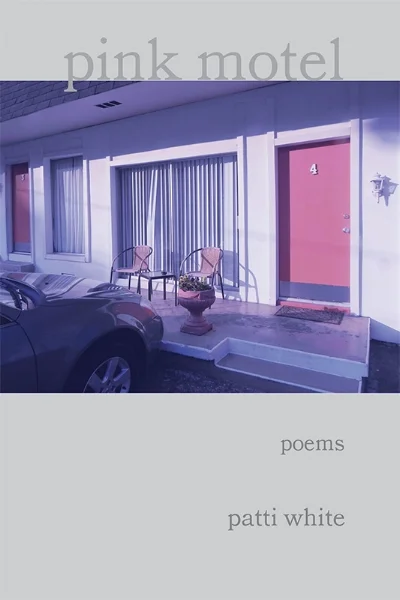
"You hold in your hands the map for a sumptuous wander. And you are promised the ocean. Promised crackers cracking almost like bones. Promised trickster maps and miasmic roads and dryads. Via relentless tinkering with the interiors of the mind. Via apocalyptic tectonics. Like Browning’s Childe Roland, Patti White’s Lucy comes nose to nose with the central questions of any quest: is she fit to see; fit to fail; succeed; move even? I am moved to observe that every hole opened along the way overwells and overbrims to flooding with White’s clipped and kinetic music. You will be haunted — gaunt and lonesome some. But just like the ocean wallows forever in every shell, Patti White’s etched, exacting image-making will sound and spellbind you long after." — Abraham Smith
Poems
OCTACHORON
A tesseract of grief. The empty platform
a glacier melting in fluorescent light. She
sees the vanishing point of the rails and
thinks she could disappear gleaming like
smelted iron, her life a line of liquid sun.
Maybe it is five hours since the bombs fell.
Maybe a mist rises from the ravine where
the dead are gathered like a burned forest.
Lucy wears a loose floursack dress and
a cardigan frayed by months of wandering.
Maybe the caramel suitcase tied with string
brass locks and corners watered silk inside.
Maybe a mystery without a solution a house
without a key a broken spine like a fit of rage.
She waits on the platform holding a ticket.
She knows this will be the last train forever.
***
The notes left on ruled paper blue-ink letters
to the missing from survivors sad to be alive.
The turnstile rusted shut. The awful silence.
She has already checked her bag or bent
to tie a shoe or wiped her neck with a rag
moistened at a water fountain. She thinks:
dream trains are always locals, stopping
everywhere but just where you are going.
***
Here is grief made four dimensional,
railway lines connected and edged in
space a frozen object flung wide and
whirling the cubist universe of loss.
EBOLA EYE
Vaccine comes like rain into Knoxville
a thousand needle sticks and Band-Aids
some viral cubes of sugar, and who knows
what will work? Lucy has seen this movie:
patient zero walks into town crying blood
someone finds a sick monkey trembling
outside the Winn-Dixie, free clinics fill with
the near-dead, the reaper comes and goes
somehow the world survives, but maybe
this time the virus hides along a nerve or
curls and clusters inside the eye, knotted
like a nest of snakes and she feels so tired,
as if she’s been walking the earth forever
infected with omens, her heart scalded,
her eyes alarmed by everything she sees.
***
The dry rasp of bat wings or the zipper of
a hazmat suit. A bed drenched in Clorox,
yellow contagion tags, a mosquito net and
yes, she does feel a bit ill, not quite herself
her spleen pinched with an alligator clip or
her throat swollen or straitened or sore and
one day she wakes up with a fever, or not,
maybe she’s perfectly fine, she says she is,
but the quarantine closes in around her and
then they are napalming the neighborhood.
***
Lucy remembers a story: time travelers in
the sweet season before the plague hits,
the days so poignant and delicious, small
injection sites still raw on vulnerable wrists.
CITROPHILIA
A yellow moon spinning in orbit. A night under stars like blossoms, hillsides fogged with pollen, the groves shadowed and sweet. How that air fell on the skin like a lover’s breath, she thinks, how leaves glittered in the headlights as she swept across the state. The spack spack spack of insects against the windshield. A flash of black water or a plastic bag in the ditch. At the end of the road an airplane or an ocean, wire baskets of lemons on counters, glass pitchers stirred with simple syrup, her heart a poetry of rind and pulp. Lucy keeps a map of Florida in her car just in case and when the weatherman calls for an eclipse she waits outside and watches, remembers mist rising from the road like smudgepots in winter, high winds behind the storms, a wildfire of armadillos blazing through the groves.
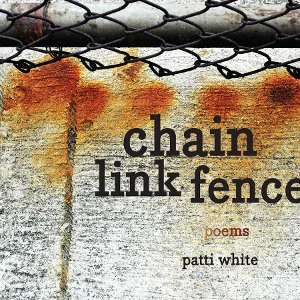
A catastrophic post-pastoral, nightmared and sung by a tornadic imagination. Chain Link Fence offers "plot" as "a series of shapes, a choreography." And here the dream replaces our dreamer, "an eggshell of / air around the world, a crust of salt, / the sphere of her eye quivering, un- / able to take it all in." White's linkage of luminescent image trades in visions rather than narratives. -- Peter Streckfus
Cover art: photograph, "Metal Fence," isaravut/shutterstock.com
#39
For Lucy, a plot is a series of shapes, a choreography,
motion in a field of high grass, wild water in a creek,
a bunker on the beach a chain link fence half buried
in sand an open weave sweater the daughter in the
breezeway clutching cardboard spattered in red and
yellow the woman with her feet under the faucet
#54
From here (and where?)
she can see all the stars in space and
the coastline, erasable, like reality,
something so fragile, an eggshell of
air around the world, a crust of salt,
the sphere of her eye quivering, un-
able to take it all in.
#55
A swarm of bees, beating in her chest, she feels their wings,
a buzz in her heart, a startling on the edge of consciousness,
like that twist at the top of the wire, that shivering tornado of
metal, the light breaking on rough edges, scattering like bees
rising from a field of flowers, spiraling into the air.
Lucy herself, fingers twisted in the wire of the fence.
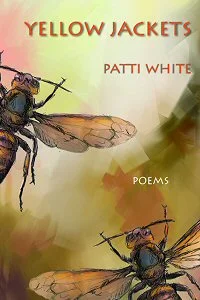
Patti White's new book, Yellow Jackets, is wildly ventriloquistic. Where else would you find sumo wrestlers, Izzy the cat, King Louis the Child, Jimmy Hoffa, the residents of Thicketty, South Carolina, couples at their burnt-out ends, and yellow jackets in one collection? All empathetically expressed, and without a single repeat. If you're bored with books about what the poet ate for breakfast, this one, with its refreshing lack of ego and its generously associated images is surely worth a look. -- Lola Haskins
Praise for Tackle Box, also by Patti White: Patti White's voice is authoritative, witty, and persuasive. She can take the most trivial subject and give it substance through her imaginative vision... To read these poems is to be invigorated, to feel the possibility of moving outside the confines of one's own narrow personal life. But dynamic vision is not all White offers. Her language is radiant, intensely lyrical at times, in spite of its driving narrative force. Perhaps that is why they seem to be the poems of some Wonder Woman or High Priestess, or the kind of woman we would all be honored to know. -- Diane Wakoski (Judge, 2001 Anhinga Prize for Poetry)
Yellow Jackets
The social wasps swarm in September
searching out sugar, discarded sodas,
following a woman's fruity perfume;
they are careless in their hunger,
falling into paint cans, entering cars,
driven to consume, to sip and sample,
and often, hungry, angry, to sting.
The queens have already flown and mated
and abandoned the colonies that raised them.
The queens have found shelter
and will survive the winter,
the long nights without food,
the freeze that kills
every worker, every wasp, every yellow jacket
in every nest. Only the queens survive.
The social wasps are very much like bees,
colonial, matriarchal, single-minded, venomous,
like irritable makeshift wild bees, forced out
to build honeycombs out of scrap wax and sawdust
or the victims of the robber bees, come home
to find the hive overturned, drones slaughtered,
and the scent of the queen just fading
as if traced in paraffin and burning away.
Sweet bees trade honey for safety,
live domesticated in boxy pastures.
But wasps make no concessions.
Hornets, ferocious, hostile, bear no insults
but return each provocation with brutal assault;
mud-daubers are solitary but fierce, deceptively
slender, precise and cool inside adobe walls.
The yellow jackets seem benign in comparison,
awkwardly climbing inside grapefruit rinds, watching
beside hummingbird feeders for the last drop of syrup,
or trailing wistfully behind a child carrying candy.
Only two or three will appear on the screendoor
never the great swarms that smother their victims,
stinging behind the eye, inside the throat, settling
like a blanket on unfortunate postmen, pursuing
the ambulance as it speeds away, a patient swelling
with serum, breathing on a ventilator, in shock
or cardiac arrest, already dead, still screaming.
Their territory is the trailer, the trashcan, the drive-thru window,
they hunt in small groups, buzzing like flies, in complete disorder.
You can laugh at a yellow jacket and brush it off your sleeve.
But think how implacable a destiny. Each autumn, apocalypse.
The entire colony, save one, annihilated.
What dreams that queen must have, all winter,
bloated on the sweet lives of a thousand thousand sisters.
She sleeps curled in her refuge, fertile, well fed
resting from the arduous mating flight, groomed by
the workers whose bodies now drift like dried leaves
from the place where the cold night took them.
How can she bear the months of isolation?
Her dreams recount a population sacrificed
for the continuity of her kind. The wings beating
inside her head must drive her mad.
When she wakes, alone, near starved,
the world of yellow jackets will start over.
The new colony will be ruled by her scent,
her dispensation, her sharp covenant;
young queens, all but one, will be
stung to death before they can hatch.
The new queen will be tended by her infertile sisters;
she will be fed with the history of her waspish race
and grow large on tales of disaster, of plague and fire,
a generation dropping suddenly from the sky, frozen
and lost forever. She will understand her mission
to be the preservation of a culture already frantic
with the nearness of the last days, gorging
on the last sugar they will ever taste, such sweetness
in the face of catastrophe that any yellow jacket
will fling itself into certain death for just a mouthful,
a grain of sugar to take back to the nest,
sugar for the queen, for all her sisters,
a morsel of sweet life, of a future, anything at all.
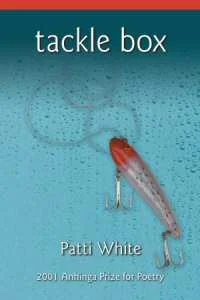
Robert Dana-Anhinga Prize for Poetry (2001)
These poems are the best lures I've picked up in a long time. No - they've picked me up. Patti White can talk tough, but be oh so embraceable. -- Gary Gildner
These poems offer a unique perception of the world, almost primal in their energy and power but, also couched in the sophistication of global myth and literature. Patti White's voice is authoritative, witty, and persuasive. She can take the most trivial subject and give it substance through her imaginative vision. Like a shaman, she offers reverence for life and the living, but this is no soft-focus new age shaman afraid to touch blood or penetrate mysteries. To read these poems is to be invigorated, to feel the possibility of moving outside the confines of one's own narrow personal life. But dynamic vision is not all White offers. Her language is radiant, intensely lyrical at times, in spite of its driving narrative force. Perhaps that is why they seem to be the poems of some Wonder Woman or High Priestess, or the kind of woman we would all be honored to know. -- Diane Wakoski
Tackle Box
People who fish have a peculiar love for equipment,
for paraphernalia, for spatial coordinates,
trajectories, for the tension between surface and depth.
People who fish know there is more to water
than can be seen by the naked eye, more to a lure
than shape and dazzle, more to filleting than a long
sharp knife; people who fish are patient, dedicated;
they understand the relation between desire and deed.
Down in South Florida, an old couple fished together
for fifty years in the green water of the salt bays,
the black water of springs in turpentine country,
the wide flat saucer of Okeechobee, the sweet rivers,
the brackish mangrove swamps, the shallow Gulf where
big rays come to breed in August, the Everglades,
fifty years on the waters of Florida, fifty years
of setting traps for bait, filling the thermos with
morning coffee, checking the barometer, scaling fish.
She had precise notions about ordering her tackle;
she kept her hooks sharp, her bloodstained stringer
neatly wound and stored; she had her own supplies:
Bandaids, Maalox, Teaberry gum, leaders, sinkers,
ten pound test line, red and white bobbers, Coppertone,
aspirin, antibiotic cream, nitroglycerin pills,
so it made sense to him, when she passed away,
to keep her ashes in her tackle box, for love.
One afternoon two thieves came to the trailer
when the old man was away and couldn't believe their
luck.
They came for electrical appliances, carelessly displayed
credit cards or checks, maybe a gold watch or a wedding ring
left lying on the sink after washing up; petty thieves, young,
they came for the obvious, the quick sell to the fence
and found a metal box full of drugs near a rusty bait bucket.
They bolted from the trailer and went directly to Castroville
where Jesus Huerfano purchased the drugs for a reasonable
but not extravagant sum; the thieves walked away with cool cash
and two small packets of white powder for a treat later on.
Jesus made it a rule to sample his product and when he sniffed
he felt the rush, a rather strange sensation, rather glittery,
but certainly, clearly, a chemically induced alteration,
so the drugs went on the street that evening.
Oh that bone cocaine, the soft ash,
so fine, so white, so
insidious. Two weeks later a stock broker found himself
drawn to the Walmart where he stood staring at the lures
for half an hour, the plastic crabs, fluorescent shrimp,
the Bass Rat, Orange Poppers, the Super Guido Frog,
the Rebels, Rappalas, the Mepps Black Fury,
the Daredevils, Silver Minnows, Scattering Shad,
the 6" Twirl Tail Worms. The merchants in town were
surprised
by a run on waders, surf rods, and insect repellent. Charters
rented out to oddly inept men, sniffling trollers whose
needle-marked arms burned in the sun, teenagers
driving BMWs lurked near marinas, and two bait shops
were looted on Sunday night. The two thieves
signed up on a tuna boat and worked the season.
And Jesus Huerfano had dreams of glistening fish
skipjacks and mullet, sheepshead, silvery sea trout,
mysterious redfish, grouper, flounder, and tarpon
he dreamed of fish head soup and grainy oysters
of deep fried snapper throats and conch fritters
he dreamed of soft white sand at the bottom of the sea
and glittering bones that shifted, drifted, so gently,
with the pull of the waves overhead
he dreamed of shining bones
dancing in the current as the fish sailed by.
The Love Zombies
We scorched them the night they came through.
We burned the cornfields under their feet,
poured gasoline down the rows and tossed matches.
They just kept on, lurching toward the farmhouse;
the sheriff said it was love that drew them,
he said they were greedy for the taste of love.
Their need was insatiable, terrible. Dire.
I saw one stop, stop and spread his arms wide
embracing the corn, hugging it to his breast,
so hungry for love he would hold dry stalks
like a cherished woman, so lonely he would
walk through fire to approach a living heart.
The sheriff followed them down the road, blue lights
flashing on their charred coats, siren wailing softly;
we stepped back to let them pass. Blackened, ashy,
they walked barefoot on gravel, on hot coals,
dragging gunny sacks of mementos behind them:
livers, knuckle bones, pressed flowers,
tin can lids, movie tickets, gallstones,
umbrella ribs, moving slow as threshers,
they shuffled along the fenceline, stumbling blind,
away from our precious farms. We never knew
where they went after we burned them out.
I guess they blended with the population;
I guess they went underground in the cities
traveling through utility tunnels, tracing
steam pipes to exclusive apartments, watching
church weddings and old musicals, hiding
behind newspapers, waiting on park benches,
feeding on pizza crusts, feeding on memories,
dreaming of the tiny shoots of green corn,
the lettuce, the spinach, romaine, cool thin leaves
between their toes, dreaming of fullness, the grain
of love swelling their stomachs, hunger satisfied,
life replenished, the cornfields waving to them
across the smoky past, the farmers with open arms,
the harvest ready to be gathered, the hunger
satisfied, the love sheriff leading them home.
Alphabet
Algiers, Louisiana seemed exotic, a dark sexy bayou where
Burroughs nailed together orgone accumulators. Crossing
cottonfields worked by convicts, they high-balled west,
driving through the nights half drunk with stars, writing.
Even the dark hills of Pennsylvania were estranged by
falling rain, the slick and slippery shale of memory.
Ginsberg sent love letters to everybody, regardless,
Huncke, Corso, garbled messages of semen, stamps
inching off the envelope toward California, toward
Jack, and in every line he's screaming out: angel!
Kerouac! the trains in the night! Lovelorn, he mailed
letters; Burroughs answered with persistent insects,
mugwumps conspiring to invade his head like police
nostalgic for torture, like eager surgeons, or lepers
off-loading dead skin in packages wired to explode,
posted traces of kisses from opium dens, the
queers and junkies eating oranges in Tangiers.
Rising poets remember them, read them, take
solace in the beat journey across America, in
the boys sleeping by the side of the word
under the hobo sky, dreaming against the
vanity of form, riding the rails down the line.
What language do they speak, what sweet
X-ray skeleton grammar, what tongue, the
young poets three generations later, tasting the
zest of Burroughs' oranges, in Algiers, wasting.

The working title for Pink Motel was Book of Maps. Almost a hundred places were counted in a casual survey of this wonderful book of poems. The persona of Lucy takes the reader across the U.S., in all its glory and grief.
Hit the road with Lucy and submit your map of her travels. Entries will be judged on esthetics and whimsy and of course, their “Lucy-ness.” Please submit a jpg or pdf file of your entry on Anhinga Press’ Submittable page. The entry fee is $5.
Prizes include a signed copy of all the books by Patti White has published with Anhinga Press (Tackle Box, Yellow Jackets, Chain Link Fence and a fresh new copy of Pink Motel), and 50 percent of the entry fees. Since we’ve never done this before and Anhinga Press is definitely a non-profit press, we want to break even. It will be fun; it could be profitable; or, it could be lunch! Other entries will be posted on the Anhinga website, Facebook and Instagram.
Lynne Knight, co-director of Anhinga Press and editor/designer of Patti’s Anhinga books, will judge.